Sourcing printed Eid greeting cards from China
Printed Eid greeting cards from China carry 0% UK import duty across the listed formats, with no anti-dumping or countervailing measure recorded. Businesses must not sell cards they know, or should have known, are unsafe. Approve the Arabic wording and a printed proof before production. Cambridge China Bridge sources printed Eid greeting cards.
Buying from China for a business? How our UK China sourcing agent service works · China sourcing agent for small orders and first imports
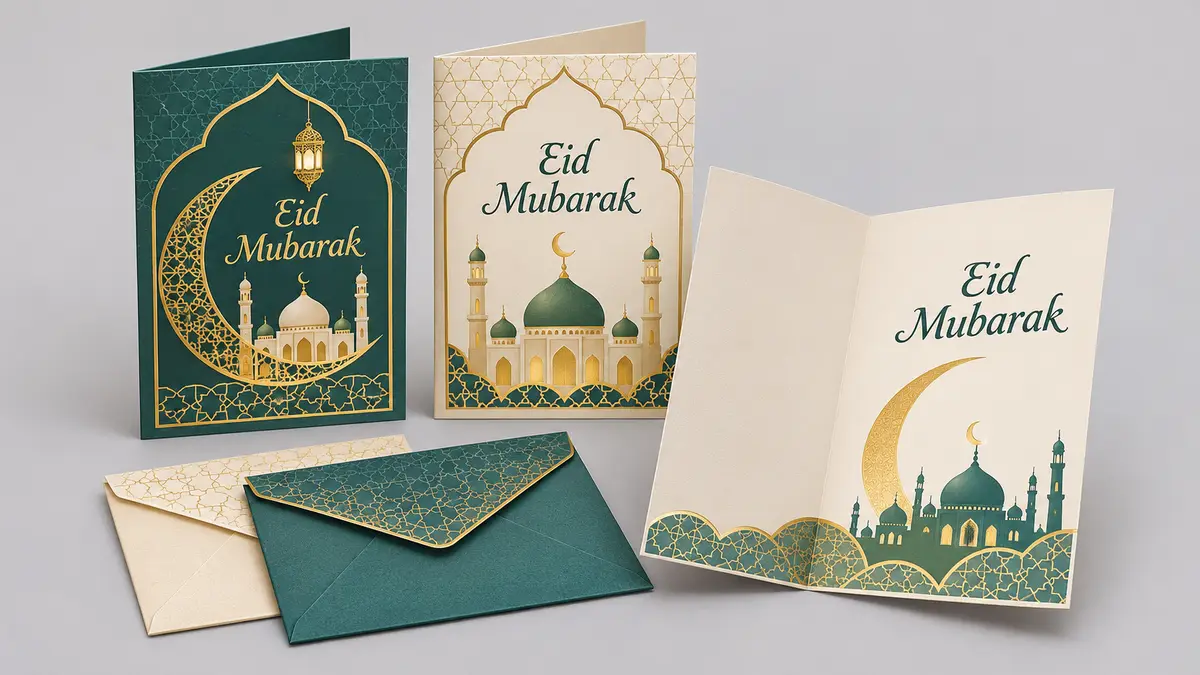
Duty on printed Eid greeting cards
Read from the UK Trade Tariff on 4 October 2026, heading 4909 covers printed cards bearing personal greetings, whether illustrated or supplied with envelopes or trimmings. Printed Eid greeting cards fall within this description. The table shows formats sharing the single commodity line supplied, rather than separate tariff classifications.
Goods from China under 4909 00 00 00 carry 0% duty. The supplied record lists no anti-dumping or countervailing measure and no suspension. It attaches a DCMS Export Licence control, with a document waiver for goods produced less than 50 years ago. Official guidance states that cultural-interest imports into Great Britain have no licensing requirement. Ask your customs broker to confirm how the attached control applies to your shipment.
Confirm the finished product's commodity code, especially if adding sound modules or lights. For the wider heading, see greeting cards and postcards. Keep duty separate from import VAT when comparing costs; see UK import duty and VAT.
| Goods | Commodity code | Duty | Anti-dumping or countervailing duty on China |
|---|---|---|---|
| Printed Eid greeting cards with envelopes | 4909 00 00 00 | 0% | None |
Specify the Eid wording, board and finish
State whether the range is for Eid al-Fitr, Eid al-Adha or both. Approve the exact greeting, Arabic letter connections, reading direction and any translation with a competent reader. Supply final artwork rather than asking the printer to retype calligraphy. Agree the front, inside and back designs, including whether the inside is blank for handwriting.
Specify folded dimensions, board weight, grain direction, coating, foil colour, embossing and envelope paper. Approve a physical proof on the production stock, including the writing surface. For assorted packs, agree the design mix and envelope allocation. Confirm your rights to use the artwork with a qualified intellectual-property adviser; sleeves and envelopes also bring packaging producer responsibility questions.
Businesses must not sell consumer products they know, or should have known, are unsafe. Consider loose glitter, detachable decorations and sharp cut edges when choosing finishes. Keep this specification for paper cards; sound or light versions need a separate review of the battery and electrical questions described in the wider guide.
Worked duty example
Illustrative example, not a quote: Illustrative order: 20,000 printed Eid greeting cards with envelopes under 4909 00 00 00, invoiced at £6,000 free on board, with £800 of freight and insurance to the UK. The customs value is £6,800. Duty at 0% is £0. Import VAT at 20% is charged on the customs value plus duty, £6,800, so it is £1,360. With no duty, the only import tax is the VAT, which a VAT-registered importer can usually reclaim. The import duty and VAT guide explains each step.
Inspection checklist
Artwork: compare front and inside text with the approved files, checking Arabic joins, reading direction, spelling and the intended Eid greeting.
Print and finish: compare colour with the physical proof; rub foil and glitter, check fine calligraphy for filled gaps, and inspect folds for cracked ink or coating.
Card and envelope: measure against the agreed specification, check that cards stand as intended, test handwriting on the inside and insert finished cards into their envelopes.
Packs and cartons: check the agreed design mix, card and envelope counts, barcodes, crushed corners and moisture damage during quality inspection.
Working out your own order? Send us the product on WhatsApp and we reply the same working day: WhatsApp us
What goes wrong
Arabic lettering can become disconnected or reversed when fonts are substituted or artwork is retyped. A generic greeting may also be replaced with wording for the wrong festival. Approve the final print file and a physical proof, then compare production samples with both.
Foil can fill the small spaces in calligraphy, dark printed areas can crack along the fold, and coated interiors may resist handwriting. Tight envelopes can scuff raised decoration. Approve the card, finish and envelope together, and check each design in an assorted pack rather than only the outer packaging.
Cambridge China Bridge sources these products for UK businesses, checking the factory and the documents before shipment. See factory verification. For repeat volumes, see container programmes.
Frequently asked questions
What is the UK import duty on printed Eid cards from China?
The supplied UK Trade Tariff record shows 0% duty under 4909 00 00 00, with no anti-dumping or countervailing measure recorded. Import VAT is separate.
Can the factory prepare the Arabic greeting?
Supply approved wording and final artwork. Have a competent reader check letter connections, reading direction and meaning before approving the physical proof.
Do printed Eid cards need a cultural-goods import licence?
The tariff record attaches an export control; ask your broker to confirm its treatment.
What should I check on foil Eid cards?
Check that fine calligraphy remains readable, foil stays attached when rubbed, folds do not crack and raised decoration fits the envelope without scuffing.