Sourcing desk tent calendars from China
Printed desk tent calendars from China carry a single UK duty rate of 0%, with no anti-dumping or countervailing duty recorded. Confirm the applicable VAT treatment with HMRC or your customs broker; if standard-rated, budget for 20% import VAT. Approve the date file and an assembled sample before printing. Cambridge China Bridge sources printed desk tent calendars.
Buying from China for a business? How our UK China sourcing agent service works · China sourcing agent for small orders and first imports
UK duty on printed desk tent calendars
Read from the UK Trade Tariff on 2 October 2026, heading 4910 covers calendars of any kind, printed, including calendar blocks. Printed paper or card desk tent calendars fall within this description. The supplied tariff file contains a single commodity line, 4910 00 00 00; the table shows product formats sharing that code, rather than separate tariff subdivisions.
Goods from China carry 0% duty, with no anti-dumping or countervailing duty and no suspension recorded. The tariff record attaches a DCMS Export Licence entry. Official guidance states that cultural-object imports into Great Britain have no licensing requirements. Ask your customs broker to confirm how the attached entry is handled for your shipment.
Confirm the VAT treatment of the printed calendars with HMRC or your customs broker; if standard-rated, import VAT is 20%. Confirm the finished construction and description using finding your commodity code, especially if the calendar includes a separate holder or other goods. See the tear-off desk calendar guide for another format within the wider heading.
| Goods | Commodity code | Duty | Anti-dumping or countervailing duty on China |
|---|---|---|---|
| Printed folding-card desk tent calendars | 4910 00 00 00 | 0% | None |
Specify the date grid and standing base
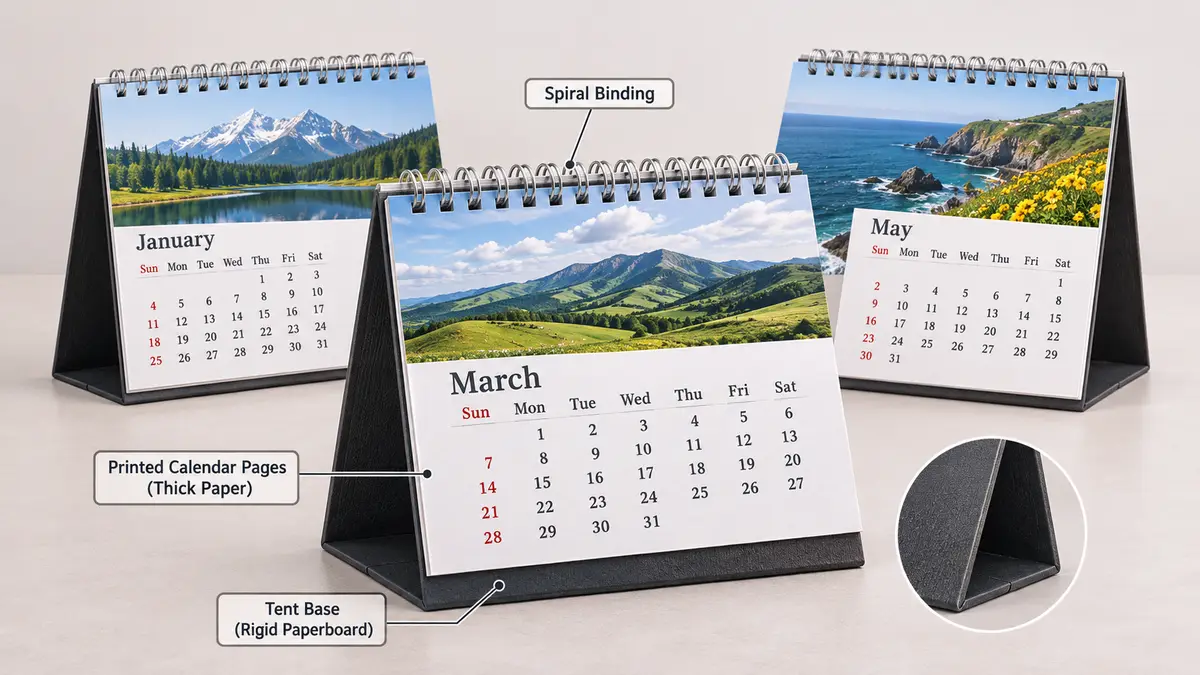
Choose a fixed folding-card tent or turning pages on a folded base. Specify the finished footprint, standing height, base board, page paper, surface finish, crease positions and base closure. For bound versions, agree the binding and enough clearance for pages to turn without pulling the base over. Approve an assembled sample made from the intended materials.
Supply a checked date file, the intended UK holiday region, week layout and final artwork. Agree what appears on each face and keep the logo clear of folds and binding holes. Approve a printed proof on the ordered stock, not just a screen image. Check that the date grid remains readable when the calendar is standing.
If the calendars are supplied as consumer products in the UK, the importing business is responsible for their safety. Include checks for exposed binding ends, loose components and rough edges in the sample review.
Worked duty example
Illustrative example, not a quote: Illustrative order: 20,000 printed folding-card desk tent calendars; FOB and freight values are illustrative, not a quotation. under 4910 00 00 00, invoiced at £6,000 free on board, with £800 of freight and insurance to the UK. The customs value is £6,800. Duty at 0% is £0. Import VAT at 20% is charged on the customs value plus duty, £6,800, so it is £1,360. With no duty, the only import tax is the VAT, which a VAT-registered importer can usually reclaim. The import duty and VAT guide explains each step.
Inspection checklist
Dates and artwork: compare the final printed calendar with the approved date file, checking weekdays, holidays, month sequence, logo placement and the orientation of each face.
Base and binding: assemble samples on a flat desk, check that the base stays open and level, turn every page, and look for loose wire ends, torn holes and splitting creases.
Print and materials: compare colour with the signed proof, verify the ordered paper and board, and check trimming, ink rub, lamination lifting and cracking along folds.
Packing and arrival: check carton counts, protection around bindings and folded bases, and signs of moisture or compression. Reassemble arrival samples to identify warped bases and pages that stick together.
Working out your own order? Send us the product on WhatsApp and we reply the same working day: WhatsApp us
What goes wrong
A tent can look correct while flat but collapse when opened because the base board is too flexible or the closure does not hold. A tight binding can drag the base over when pages turn. Poor crease placement leaves the calendar leaning, while incorrect artwork orientation puts a face upside down after assembly.
Reused date templates can leave weekdays or holidays wrong. Colour drift, lighter paper and damp cartons can turn an approved sample into unusable stock. Keep the assembled sample and signed print proof as inspection references, and agree the checks before production. Use the quality inspection guide to brief the inspection.
Cambridge China Bridge sources these products for UK businesses, checking the factory and the documents before shipment. See factory verification. For repeat volumes, see container programmes.
Frequently asked questions
What is the UK import duty on desk tent calendars from China?
The supplied tariff record, read on 2 October 2026, gives 0% duty under 4910 00 00 00, with no anti-dumping or countervailing duty recorded.
Do printed desk tent calendars pay import VAT?
Confirm with HMRC or your customs broker whether the printed calendars are standard-rated; if so, import VAT is 20%. Ask them to confirm whether any zero-rating treatment is available rather than assuming the calendars receive the same treatment as books.
What should I approve before printing desk tent calendars?
Approve the checked date file, a printed colour proof on the ordered stock and an assembled sample. Check standing stability, face orientation and page-turning clearance.
How do I stop desk tent calendars arriving bent?
Agree protection for bases and bindings, moisture protection and carton packing. Inspect for crushed corners and warped board, then assemble samples when the shipment arrives.