Sourcing dried pig bladders from China
Dried pig bladders from China carry 0% UK duty under the casing or other line. Food casings require an approved processor, a health certificate and a China-specific testing declaration. Confirm treatment and import eligibility before ordering. Cambridge China Bridge sources dried pig bladders.
Buying from China for a business? How our UK China sourcing agent service works · China sourcing agent for small orders and first imports
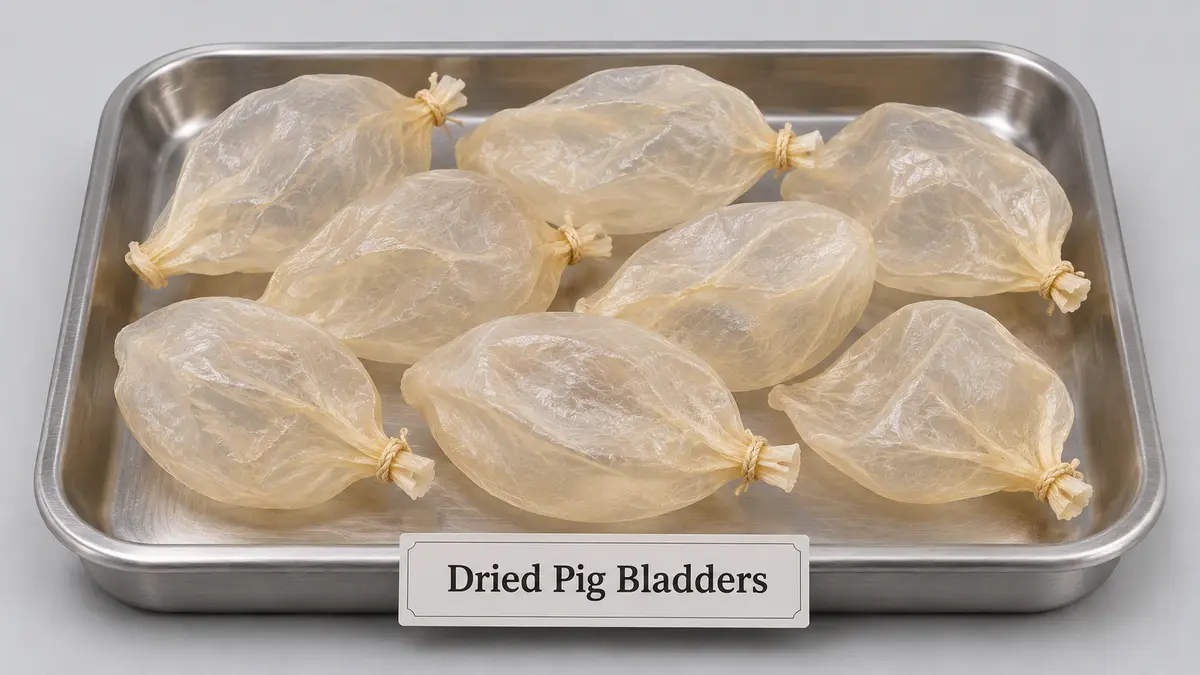
Zero duty, with animal-origin controls
Read from the UK Trade Tariff on 8 October 2026, heading 0504 covers animal guts, bladders and stomachs other than fish, whole or in pieces, including dried products. Both the casings and other lines carry 0% duty for goods from China. The supplied tariff facts record no anti-dumping or countervailing duty and no suspension.
The tariff attaches veterinary, organic-product and CITES import controls, plus a CITES export control. Food casings need an approved establishment and a health certificate; confirm country eligibility, pre-notification and border-check requirements with the relevant authority or your customs broker. Chinese casings also require a competent-authority declaration covering pre-dispatch chemical testing and its results. For organic claims and the species-specific CITES position, ask your customs broker to confirm the applicable requirements.
Confirm whether the product belongs in the casings or other line using finding your commodity code. Whole bladders and pieces can share a tariff line. The table shows product forms under the supplied codes, rather than separate codes for each form. For the wider heading, see natural sausage casings.
| Goods | Commodity code | Duty | Anti-dumping or countervailing duty on China |
|---|---|---|---|
| Whole dried pig bladders, for use as casings | 0504 00 00 10 | 0% | None |
| Whole dried pig bladders, other uses | 0504 00 00 90 | 0% | None |
Specify the bladder and its treatment
Specify pig species, intended use, whole bladders or pieces, dry dimensions, usable capacity after soaking, neck opening, wall condition and acceptable trimming. Agree how samples will be soaked and filled so the supplier and buyer assess the same condition.
Ask for the cleaning, scraping, defatting, salting and drying records. Do not treat the word 'dried' as proof of eligibility for the food-casing route. Ask the processor and broker to check the actual treatment against the applicable casing safeguard before ordering. For products not intended for human consumption, confirm with the relevant authority or customs broker whether animal by-product conditions apply.
Agree moisture acceptance, colour, odour, permitted holes and splits, packing, batch identification and storage instructions. Keep an approved sample for comparison with production and arrival samples.
Worked duty example
Illustrative example, not a quote: Illustrative only: 5 tonnes of dried pig bladders for casings, subject to import eligibility under 0504 00 00 10, invoiced at £60,000 free on board, with £3,000 of freight and insurance to the UK. The customs value is £63,000. Duty at 0% is £0. Import VAT at 20% is charged on the customs value plus duty, £63,000, so it is £12,600. With no duty, the only import tax is the VAT, which a VAT-registered importer can usually reclaim. The import duty and VAT guide explains each step.
Inspection checklist
Documents: check processor approval, the health certificate, pre-notification and the Chinese testing declaration against the shipment and batch records.
Shape and filling: compare dimensions and neck openings with the approved sample; soak and fill sampled bladders to check capacity, leaks and weak walls.
Cleanliness: inspect for residual tissue, foreign matter, visible mould, unusual staining and persistent odour after soaking.
Packing: check seals, dampness, crushed contents and batch marks on arrival; record discrepancies before mixing batches.
Working out your own order? Send us the product on WhatsApp and we reply the same working day: WhatsApp us
What goes wrong
A supplier may offer dried bladders without documenting the treatment needed for the proposed import route. An unrelated plant approval or a generic laboratory report can leave the buyer without the evidence needed for that consignment. Settle the route and documents before shipping.
Look for brittle walls that crack during soaking, uneven size, poorly trimmed openings and damp packing. A dry sample can conceal filling failures, so assess rehydrated samples as well. Use the quality inspection guide to agree how defects will be recorded.
Cambridge China Bridge sources these products for UK businesses, checking the factory and the documents before shipment. See factory verification. For repeat volumes, see container programmes.
Frequently asked questions
What is the UK import duty on dried pig bladders from China?
Both supplied lines, 0504 00 00 10 for casings and 0504 00 00 90 for other products, carry 0% duty. The tariff facts record no anti-dumping or countervailing duty.
Can I import dried pig bladders as food casings?
Confirm the recognised casing route, treatment and processor approval first. Food casings need a health certificate; confirm the applicable border procedures with the relevant authority or your customs broker. Chinese casings also need the official chemical-testing declaration.
Does drying alone prove the bladders are suitable?
No. Ask for the complete processing history and have the proposed import route checked. For performance, compare soaked and filled samples with the agreed specification.
What should I check when dried pig bladders arrive?
Check batch identity, packing dryness, odour, visible contamination, dimensions and wall condition. Soak and fill samples to find leaks, cracks and inconsistent usable capacity.