Sourcing ceramic self-watering spikes from China
Ceramic self-watering spikes from China carry 0% UK duty across the supplied heading 6914 lines, with no anti-dumping or countervailing duty recorded. Consumer products supplied in Great Britain must be safe. Specify seepage performance and reservoir fit before ordering. Cambridge China Bridge sources ceramic self-watering spikes.
Buying from China for a business? How our UK China sourcing agent service works · China sourcing agent for small orders and first imports
0% duty on the supplied ceramic lines
Read from the UK Trade Tariff on 1 October 2026, heading 6914 covers other ceramic articles. Every supplied line carries 0% duty for goods from China, so the recorded range is uniformly 0%. This guide focuses on ceramic watering spikes; see ceramic plant pots for the wider product family.
The supplied records show no anti-dumping or countervailing measures and no suspensions. The tariff attaches cat and dog fur and waste import controls. Imports of cat and dog fur and products made from it are banned. Waste shipment controls apply only to waste; for any China consignment classed as waste, confirm the applicable procedure with your customs broker. The file also lists cultural-object, fur and waste export controls; ask your broker about these before re-exporting.
Give your broker the ceramic composition, manufacturing method, photographs and details of any bottle adapters or tubing to confirm the commodity code. The table shows product variants, with bottle-fed and tube-fed forms sharing a candidate code. Confirm the classification of the actual goods supplied rather than selecting a code by appearance.
| Goods | Commodity code | Duty | Anti-dumping or countervailing duty on China |
|---|---|---|---|
| Porcelain or china watering spikes | 6914 10 00 00 | 0% | None |
| Hand-made common pottery watering spikes | 6914 90 00 10 | 0% | None |
| Other ceramic bottle-fed watering spikes | 6914 90 00 90 | 0% | None |
Specify the porous body and water connection
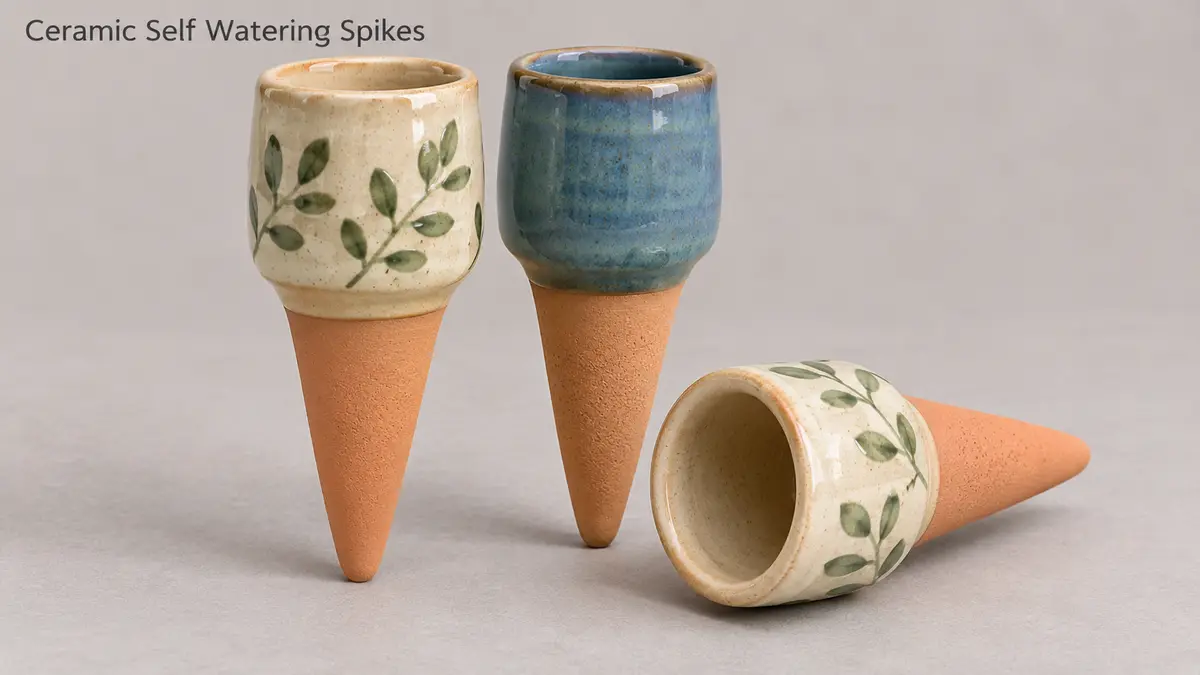
Specify the ceramic body, firing, unglazed seepage area, cone length, wall thickness and tip shape. Identify whether the spike takes an inverted bottle or draws water through a tube from a separate reservoir. For bottle-fed models, agree bottle-neck fit, adapter material and support; for tube-fed models, agree tube bore, length, cap seal and reservoir position.
Approve a functional sample using the intended bottle or reservoir and representative potting compost. Record soaking and priming instructions, water-level changes and any leakage around joints. Agree an acceptable watering pattern against this sample, rather than accepting an unsupported promise about how long a refill lasts.
Consumer products supplied in Great Britain must be safe. Check handling surfaces for sharp chips and test whether the filled bottle remains supported during use. Request freeze-thaw results before making an outdoor frost-resistance claim.
Worked duty example
Illustrative example, not a quote: Illustrative pallet order of unglazed ceramic self-watering spikes under 6914 90 00 90, invoiced at £4,500 free on board, with £1,800 of freight and insurance to the UK. The customs value is £6,300. Duty at 0% is £0. Import VAT at 20% is charged on the customs value plus duty, £6,300, so it is £1,260. With no duty, the only import tax is the VAT, which a VAT-registered importer can usually reclaim. The import duty and VAT guide explains each step.
Inspection checklist
Seepage: soak and prime sampled spikes, then compare water delivery in the agreed compost and reservoir arrangement with the approved sample. Check for dry spikes and rapid emptying.
Connections: fit the intended bottles, adapters, caps and tubing. Check loose joints, seal leaks, kinked tubes and movement under the filled bottle's weight.
Ceramic body: inspect tips, rims and walls for cracks, chips and blocked seepage surfaces. Check dimensions and reject sharp handling edges.
Packing: open arrival cartons and check separated tips, cushioning and movement inside the pack. Trial the agreed packing before shipment and record breakage. See quality inspection.
Working out your own order? Send us the product on WhatsApp and we reply the same working day: WhatsApp us
What goes wrong
A firing or wall-thickness change can alter seepage even when the spike looks unchanged. Glaze covering the working surface can obstruct watering, while cracks or leaking adapters can empty the reservoir too quickly. Poor bottle support can pull the spike sideways and break its tip.
Tube-fed models can disappoint when priming instructions or reservoir position differ from the approved test. Agree those conditions in the purchase specification and repeat the functional check on production samples. Review the actual body and firing before repeating a frost-resistance claim.
Cambridge China Bridge sources these products for UK businesses, checking the factory and the documents before shipment. See factory verification. For own-brand ranges, see sourcing for brands.
Frequently asked questions
What is the UK import duty on ceramic self-watering spikes from China?
The supplied heading 6914 lines carry 0% duty for goods from China, with no anti-dumping or countervailing duty recorded. Confirm the code for the actual spike and accessories.
Will these watering spikes fit any bottle?
Do not assume universal fit. Specify the intended bottle neck and adapter, then test the seal and support with a filled bottle before approving production.
How do I check that ceramic watering spikes work?
Soak and prime samples, use the agreed compost and reservoir position, and compare water delivery with the approved sample. Check both seepage through the ceramic and leaks at connections.
Can I sell ceramic watering spikes as frost-resistant?
Ask for freeze-thaw results for the actual ceramic body and firing before making the claim. A watering test alone does not establish frost resistance.