Can I use China insulation for internal walls?
Potentially, yes, but approve a property-specific wall design before ordering. Check moisture risks, junction details, ventilation and fire evidence for the complete assembly, then obtain written acceptance from your designer and installer. Factory documents and samples can be coordinated by Cambridge China Bridge.
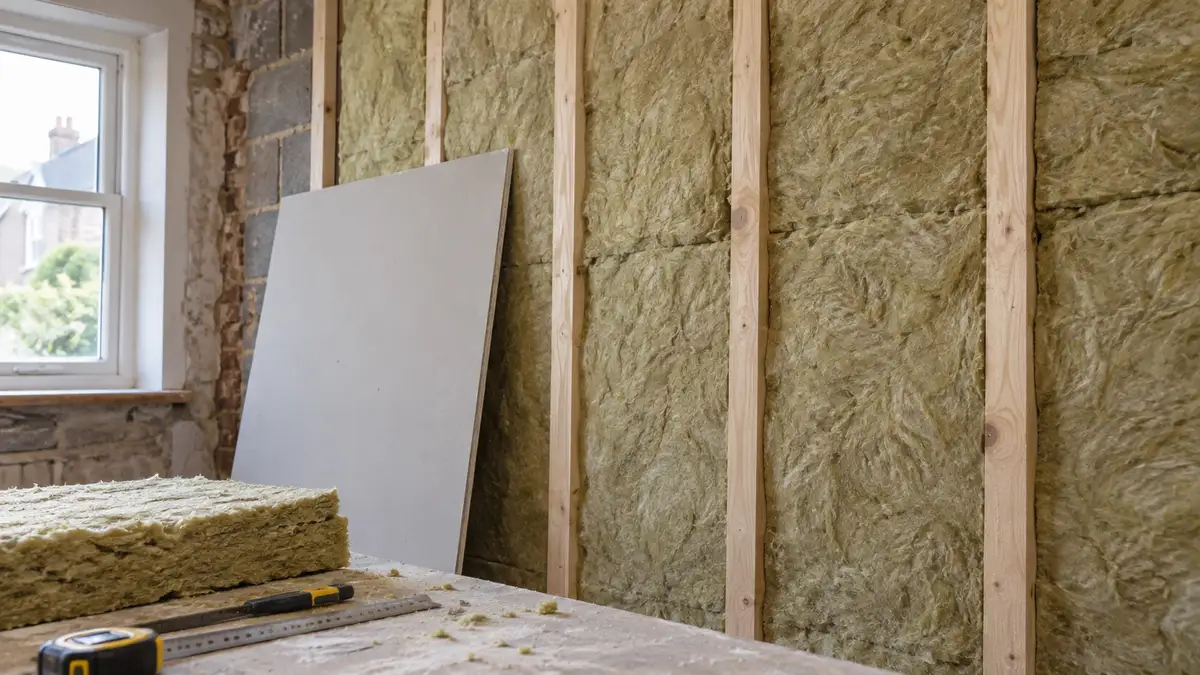
Assess the property before choosing insulation
This guide concerns insulating the inside face of external walls, rather than partitions between rooms. Commission a property-specific assessment covering wall construction, existing finishes, rain exposure, damp sources and embedded timber. Ask the assessor to explain whether the proposed build-up can manage moisture and allow drying.
Investigate leaks and damp before covering the wall. Agree repairs, drying and reassessment with the designer. Ask whether moisture modelling is needed and which assumptions it uses. Keep the findings with the sourcing brief; our construction materials guide covers the separate product-document checks.
Resolve thermal bridges and moisture details
Thermal bridges can leave cold spots where condensation and mould develop. Ask for junction drawings covering window and door reveals, floors, ceilings, internal wall intersections and any edges where insulation stops. Have the designer assess partial coverage rather than assuming each insulated patch works independently.
Ask the designer to specify insulation continuity, the air barrier and any vapour control layer, including seals around sockets and pipes. Request a schedule of compatible boards, membranes, tapes and adhesives. Do not let the factory choose a generic vapour barrier or increase thickness without technical review.
Plan ventilation alongside the wall work
Government retrofit guidance says insulation should not be installed without assessing the ventilation system. Arrange that assessment before settling the material order. Ask what ventilation changes the proposed retrofit needs, including extraction, replacement air and any combustion-air provision.
Include the agreed ventilation work in the installation scope. Ask who will check operation and provide operating instructions at handover. Have the installer identify vents and ducts that must remain clear, and resolve conflicts with insulation or new linings before work starts.
Review fire performance of the complete assembly
Ask a competent designer to review fire evidence for the proposed wall build-up: insulation, facing, lining, adhesive, framing, fixings, cavities and penetrations. Ask separately about reaction to fire and any required fire resistance. A report for a bare insulation board does not establish the performance of that assembly.
Send complete reports and installation instructions for review. Record differences between the tested arrangement and your proposed wall, including substrate and joints. Use our test report verification guide for document checks. Obtain a written decision on evidence gaps before accepting substitutions or ordering.
Working out your own order? Send us the product on WhatsApp and we reply the same working day: WhatsApp us
Get installer acceptance before releasing the order
Ask the intended installer to accept the exact materials, drawings and installation method in writing, including responsibility for fixings, sealing and concealed-work checks. Confirm their experience with the proposed system and the warranty position for buyer-supplied materials. For England and Wales, check whether building regulations approval is needed; confirm the local process separately for Scotland or Northern Ireland.
Release the order only when the designer and installer have closed the technical questions and the approval route is clear. Use our construction submittal guide to record the accepted configuration. Cambridge China Bridge's staff in China can obtain matching samples and factory records; property assessment and installation acceptance remain with your appointed specialists.
Frequently asked questions
Can I use Chinese insulation inside my house?
Potentially, if the exact product fits an accepted property-specific design. Obtain moisture, ventilation and wall-system fire reviews, plus written designer and installer acceptance, before ordering.
Can I insulate over a damp internal wall?
Investigate the moisture source first. Agree repairs, drying and reassessment with the designer before covering the wall. Insulation should not be treated as a repair for an unexplained damp problem.
Does a fire certificate cover the whole wall?
Check its scope. A board report does not establish performance with different linings, adhesives, fixings or cavities. Ask the designer to assess the complete proposed assembly and any evidence gaps.
Should my installer approve insulation before I buy?
Yes, as a purchasing safeguard. Obtain written acceptance of the exact system and installation details, clarify warranty responsibility and resolve technical questions before releasing the order.