Will a child safety gate fit my staircase?
Measure the opening at the actual fixing points, identify the supporting surfaces and check the exact model’s instructions for stair placement, extensions and fittings. At the stair top, choose a screw-fixed gate explicitly approved for that position. Arrange factory-side checks through Cambridge China Bridge.
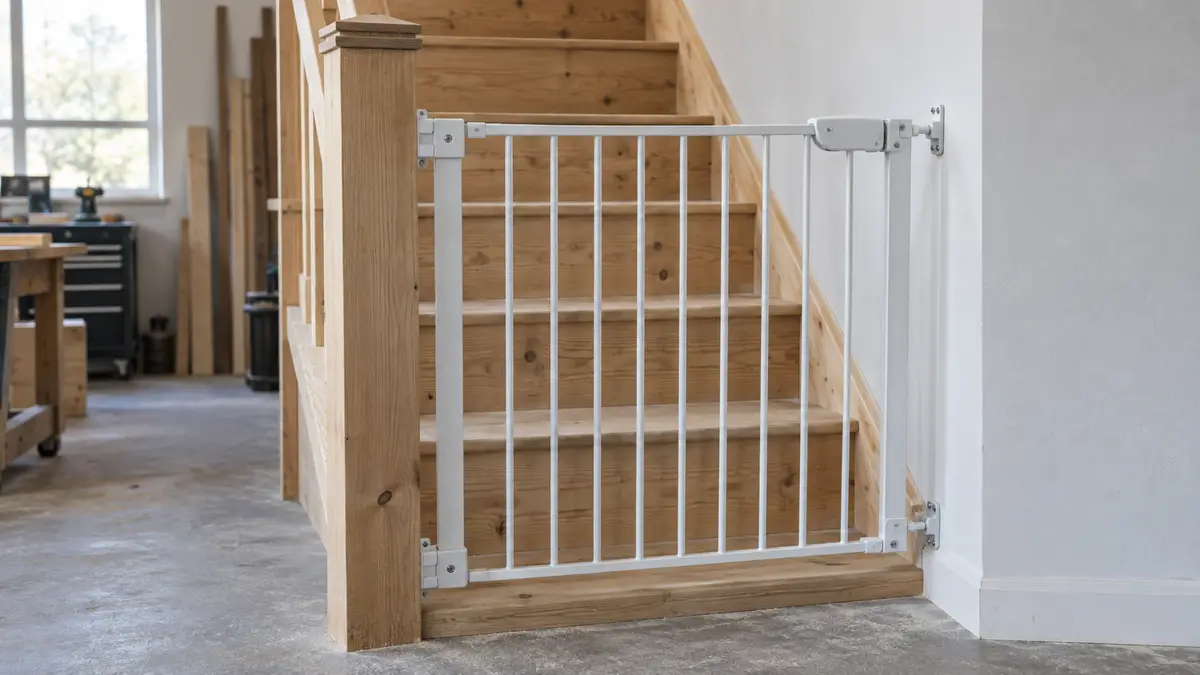
Measure the opening where the gate will attach
Photograph the staircase from the landing and the steps, then mark the proposed fixing positions. Measure the clear opening at the upper and lower attachment heights. Record skirting projections, uneven walls, sloping floors, rounded posts and any offset between the opposing surfaces. A measurement taken elsewhere in the doorway can give a misleading fit.
Compare those measurements with the instructions for the exact gate and extension combination. Check whether the stated opening range includes mounting cups, brackets and adapters. Ask the supplier to confirm the configuration against your photographs and drawing. Do not stretch the adjustment beyond its stated range or combine extensions without the manufacturer’s approval.
Check what will support the fixings
Identify the material behind each fixing position: sound timber, masonry or a hollow wall needs a different fixing assessment. Check whether a newel post is secure and whether brackets can sit flat. Decorative trim, loose plaster and a flexible banister spindle are reasons to stop and obtain an installer’s assessment.
Ask which screws, plugs, wall cups and banister adapters the manufacturer specifies for those surfaces. Supplied screws do not establish that your wall is suitable. Have an installer check concealed services before drilling. Do not improvise with packing blocks, adhesive pads or cable ties to make an unsuitable mounting position work.
Treat the top of the stairs separately
For the stair top, choose a screw-fixed gate whose instructions explicitly allow that location. Do not use a pressure-only gate there. A listing headed ‘stair gate’, or a photograph showing stairs, is insufficient: obtain the model-specific placement instructions and check that your opening and fixing arrangement match them.
Check the instructed position relative to the stair edge, the permitted opening direction and any direction stop. Avoid a gate that opens out over the descending stairs. Consider any threshold bar as a trip hazard at the landing. If the instructions are silent, contradictory or exclude your arrangement, choose another model rather than invent a position.
Approve the instructions with the actual sample
Obtain the English installation and use instructions before ordering. Match their model identification, parts list and diagrams to the gate, brackets, latch and extensions you will buy. Look for opening limits, permitted surfaces, placement restrictions, adjustment steps, locking checks, maintenance and guidance on when to stop using the gate.
Ask an adult unfamiliar with the product to assemble the sample using only the supplied instructions, away from an exposed stair edge. Record unclear diagrams, missing fittings and steps that leave the latch misaligned. Use our assembly-instructions guide for that trial and our nursery safety guide for the general safety route and standards review.
Working out your own order? Send us the product on WhatsApp and we reply the same working day: WhatsApp us
Check the installed gate before use
With children kept away, complete the manufacturer’s installation checks. Confirm that brackets and supports remain secure, the gate aligns and the latch fully engages whenever it is closed. Check any closing mechanism as instructed. Compare gaps below and beside the gate with the manual’s limits, and inspect for damage, sharp edges and accessible loose parts. Do not use a child to test the barrier.
Stop use if the gate shifts, a fixing loosens, the latch fails or a part is missing. Repeat the instructed checks after adjustment or relocation and follow the maintenance guidance. Keep nearby climbing aids away and supervise children; stop relying on the gate if a child can climb over or operate it. For business orders, add the approved fittings, instructions and functional checks to your shipment inspection brief.
Frequently asked questions
Where should I measure for a stair gate?
Measure the clear opening at the actual upper and lower fixing positions. Include skirting, uneven surfaces and post offsets, then compare with the exact model’s instructed opening range.
Can I put a pressure-fit gate at the top of stairs?
Do not use a pressure-only gate there. Choose a screw-fixed model explicitly approved for stair-top use and follow its placement, fixing and opening-direction instructions.
Can I attach a child gate to a banister?
Check the post’s strength and shape, then use only a manufacturer-approved mounting arrangement. A loose post or flexible spindle needs an installer’s assessment before fitting.
What if my China-bought gate has no instructions?
Keep it out of use until you obtain instructions matching the exact model and fittings. If the manufacturer cannot supply clear installation and use instructions, choose another gate.