Why do cartons crush after humid storage?
An initial compression pass does not establish how a filled carton performs after humid storage under sustained load. Compare production-representative packs under baseline and humid conditions, then assess both crushing strength and deformation over the expected storage period. Coordinate factory samples and corrective trials with Cambridge China Bridge.
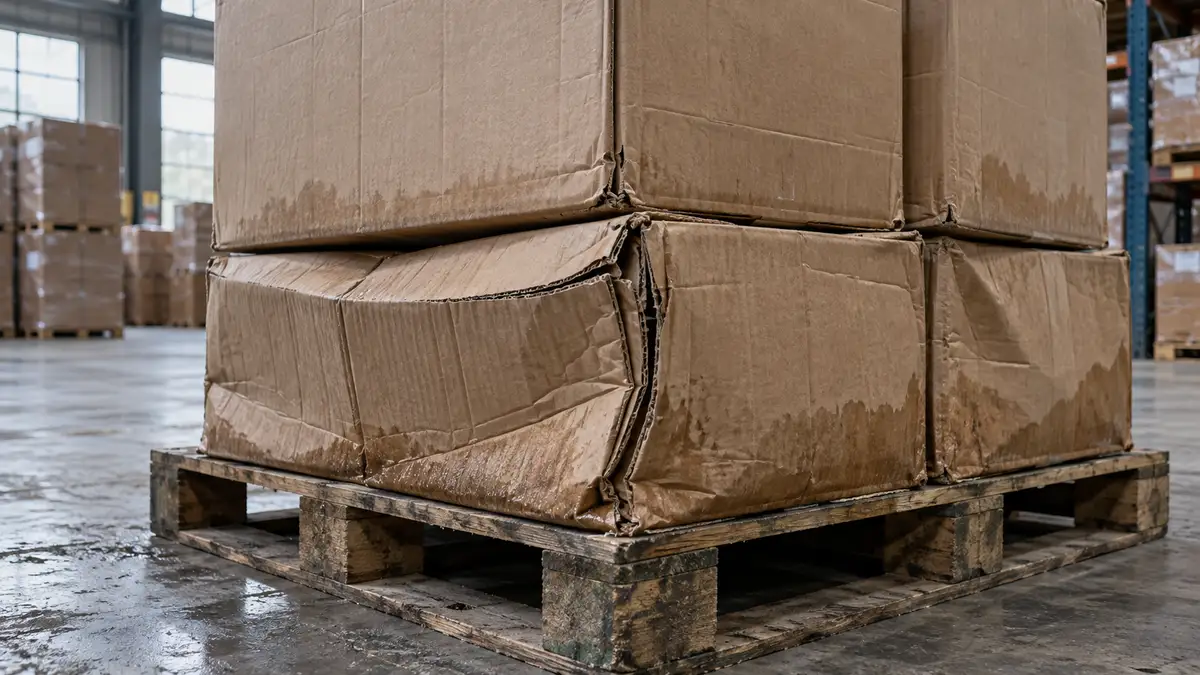
Reconstruct the failure before changing the board
Preserve failed cartons, unused cartons from the same batch and the original test report. Record where crushing began, the contents, packing date, storage duration, temperature and humidity history, stack arrangement and any wetting. Separate widespread softening from local damage at corners, joints or pallet edges.
Check whether the original test used empty or filled cartons, how they were conditioned, and whether it measured a brief peak force or resistance to a sustained load. Use our distribution packaging test guide for the wider journey; this investigation focuses on moisture exposure and time under load.
Agree moisture conditioning with the laboratory
Ask the laboratory to propose a baseline atmosphere and a humid exposure based on recorded warehouse conditions and foreseeable storage. Agree temperature, relative humidity, exposure duration and how conditioning completion will be assessed. Record carton moisture where useful, with the measurement method and sampling locations.
Condition the complete filled packs, including their actual liners, inserts and closures. Distinguish atmospheric humidity from leaks or condensation, which may need separate trials. Maintain the agreed atmosphere during testing where practicable; otherwise record transfer time and conditions so packs cannot dry unnoticed before loading.
Compare packs taken from actual production
Use independently selected production samples with the actual product, packing weight, fit, dividers, tape or adhesive and carton assembly. Record board construction, flute direction, print coverage, joints and material batches. A specially prepared empty sample cannot establish the performance of the delivered filled pack.
Compare the current carton and proposed correction under the same baseline and humid conditions, using fresh matched samples for each destructive test. Agree repeat sampling with the laboratory and examine variation rather than selecting the strongest result. Our corrugated carton sourcing guide supports the material brief.
Test storage duration as well as peak strength
Request separate short compression and sustained-load stacking trials. Base the sustained load on the actual load transmitted to the lower cartons, including pallet support, alignment and overhang. Agree a holding period that represents intended storage and foreseeable delays. Do not treat a shorter accelerated trial as equivalent without a justified method.
Track deformation, leaning, joint opening, collapse and product damage throughout the hold, rather than recording only the final appearance. HSE advises periodic stack checks because stability depends on load shape and prevailing humidity and temperature. Use our pallet stacking guide when assessing the warehouse arrangement.
Working out your own order? Send us the product on WhatsApp and we reply the same working day: WhatsApp us
Approve a correction against agreed outcomes
Before testing, agree acceptable deformation, pack stability, product protection and any limits on stacking or storage. Compare results within each atmosphere and across exposure durations. If humid packs deteriorate, investigate board, adhesive and moisture protection; if failure follows pallet edges or misalignment, investigate how the load is supported.
Retest the selected correction in production-representative filled packs before releasing affected stock. Keep sample identities, conditioning records, load histories, photographs and failure observations with the revised packing specification. Cambridge China Bridge’s staff in China can coordinate factory sampling and corrective trials against the buyer’s agreed brief.
Frequently asked questions
Why did my cartons pass compression but crush later?
The initial test may have assessed a dry pack under brief loading. Humid exposure and sustained stacking can reveal weaknesses that the original test did not assess.
Should we test empty or filled cartons?
Use production-representative filled packs for the approval decision. Empty carton tests can help investigate the board, but contents, inserts and closures change how the finished pack carries load.
How long should a humid stacking test run?
Agree the duration from intended storage and foreseeable delays. Record moisture conditioning separately from time under load. Ask the laboratory to justify any accelerated alternative.
Will thicker cardboard solve humid storage crushing?
Do not assume it will. Compare the proposed board in matched filled-pack trials and check adhesive, moisture exposure, pallet support and stacking alignment before approving the change.