Sourcing manual bread slicers from China
Specify a genuinely hand-operated slicer, its finished weight, blade protection and food-contact materials before seeking quotes. Weight affects the tariff route. Cambridge China Bridge sources manual bread slicers and coordinates samples, supplier checks and inspection.
Buying from China for a business? How our UK China sourcing agent service works · China sourcing agent for small orders and first imports
Products and search terms
manual bread slicer, hand crank bread slicer, rotary bread slicing machine, adjustable bread cutter, bread slicer manufacturer
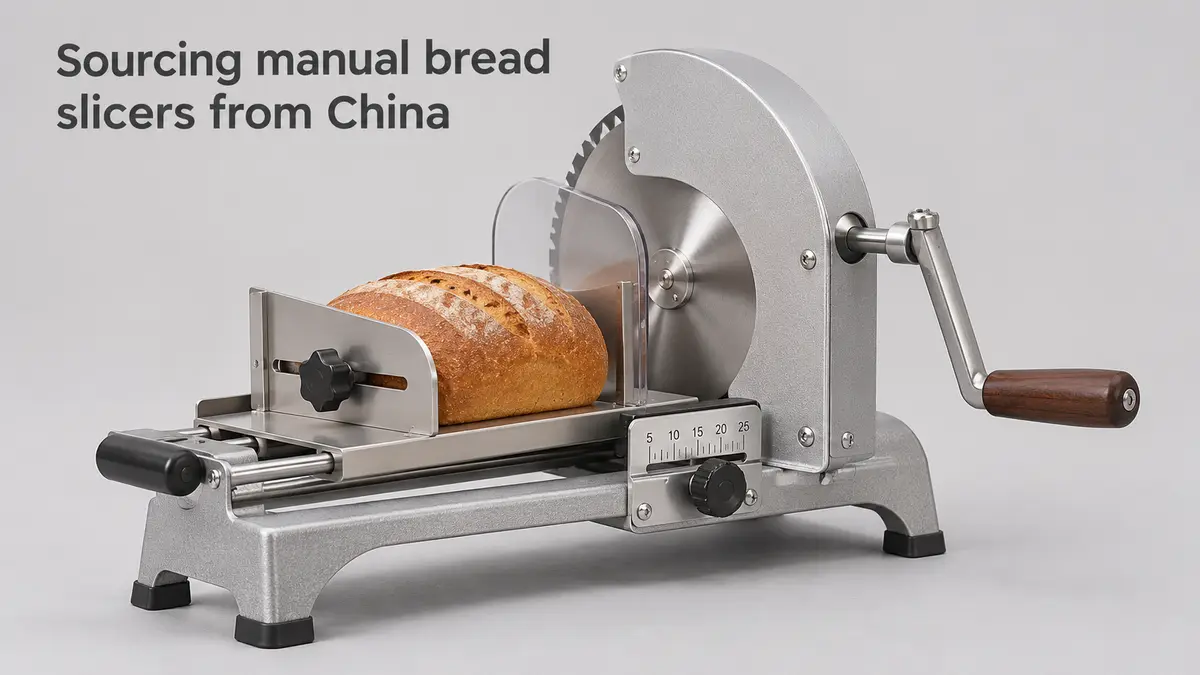
Define the manual slicer and its cutting job
A hand-cranked bread slicer uses direct human effort to move a cutting mechanism. Specify whether the design has a rotating blade, moving carriage or another cutting arrangement. This guide concerns retail products for homes and similar settings. Powered bakery equipment belongs in the separate industrial bread slicing machine guide, where the machinery and operating context differ.
Give the factory examples of the loaves the product must cut, including crust texture and crumb softness. Define loaf clearance, slice adjustment, usable cutting travel, support surfaces and storage position. Ask for the finished appliance weight rather than the packed shipping weight. Request an operating sample, drawings and material details before comparing quotations, because similar photographs can conceal substantially different cutting mechanisms.
Write a specification that can be checked
Describe how the user holds the loaf, turns the handle and keeps fingers away from the blade. Specify guards, handle attachment, carriage stops, worktop grip and the method for removing crumbs. Explain whether any parts detach for cleaning and how the blade is protected during that process. Ask the factory to demonstrate normal cutting, adjustment, cleaning and storage on video.
List every food-contact part, including the blade, loaf guide, carriage, coatings and plastic supports. Request material identification and evidence appropriate to the intended food contact, rather than accepting a generic stainless-steel description. Agree the approved sample and permitted materials in writing. Our retailers service can coordinate sample comparison, supplier questions and the retail packaging brief.
UK duty and the weight boundary
The UK Trade Tariff API, read on 3 December 2026, describes heading 8210 as hand-operated mechanical food-preparation appliances weighing 10 kg or less. That makes the complete appliance's net weight a classification input. Heading 8438 is a candidate for bakery machinery outside that provision, subject to the product's characteristics. Ask your customs agent to confirm the applicable line; greater weight does not automatically settle the alternative.
The review covered China anti-dumping, countervailing and suspension measures. The hand-operated line has a conditional airworthiness suspension, while the bakery-machinery candidate has a conditional ship-use suspension. Neither establishes relief for an ordinary retail slicer. These are UK tariff findings; prepare a separate customs brief for goods entering Ireland, with the Irish importer and customs representative confirming their treatment.
| Classification question | Candidate commodity code | Ordinary third-country duty |
|---|---|---|
| Hand-operated food-preparation appliance weighing 10 kg or less | 8210000000 | 2% |
| Bakery machinery where classification under that heading is appropriate | 8438101000 | 0% |
Food contact and consumer safety in Great Britain
Regulation (EC) No 1935/2004 on materials and articles intended to come into contact with food applies as assimilated law in Great Britain. Materials must not transfer constituents to food in amounts that harm health or unacceptably change the food's composition or sensory properties. Traceability is also required. Ask the assessor what supporting documentation and material-specific testing the proposed blade, coating and plastics need.
The General Product Safety Regulations 2005 provide the GB consumer-safety baseline where applicable. Assess foreseeable cutting, cleaning and storage hazards, provide useful safety information and identify the product and responsible supplier. A truly hand-cranked food slicer is not automatically powered machinery under the Supply of Machinery (Safety) Regulations 2008. Have the design reviewed before deciding its conformity and marking requirements, and commission a separate market review for Ireland.
Working out your own order? Send us the product on WhatsApp and we reply the same working day: WhatsApp us
Inspect cutting performance and retail readiness
Use the agreed loaf types to inspect slice consistency, carriage alignment, handle security and the tendency to crush or tear bread. Check movement throughout the adjustment range, stability on the intended worktop and guard position during use. Examine blade edges, burrs, fasteners and detachable components. Record the finished appliance weight and compare the construction with the approved sample and customs description.
After the cutting trial, inspect crumb traps, cleaning access, corrosion-prone joints and whether reassembly can leave a guard unsecured. Check that the instructions explain safe handling and the limits of the product. Inspect retail packaging for blade containment, loose parts and transport damage. Keep sample findings, material evidence and batch identification together so a substitution or customer complaint can be traced.
Frequently asked questions
Does a heavier manual slicer automatically become bakery machinery?
No. Weight can exclude the hand-operated heading, but the alternative still depends on the complete product. Give your customs agent drawings, function and net weight.
Is a stainless-steel blade enough evidence of food-contact suitability?
No. Request the actual material identity and suitable supporting evidence for the blade and every other food-contact component, including coatings and plastics.
Can the same paperwork cover UK and Irish retail?
Have both destination markets reviewed. The UK duty figures and GB product-law discussion here should not be copied into an Irish import or compliance file without that review.