How to commission filled carton compression tests
Commission a written test brief for the actual filled shipping carton. Define its construction, loading direction, conditioning, applied load and hold duration from the intended stack, then agree limits for deformation and product damage before testing. Cambridge China Bridge can coordinate the brief with its staff in China.
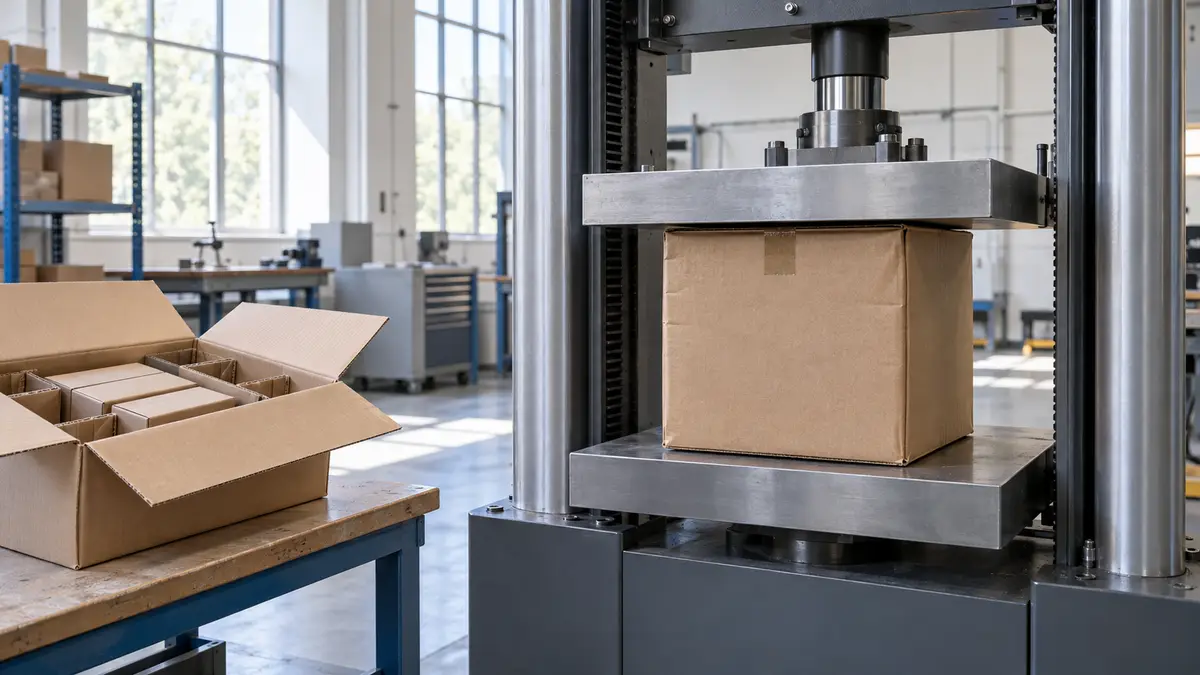
Start with the intended stack
Give the laboratory a sketch of the intended stack, filled carton weights, stacking pattern, storage duration and expected temperature and humidity. Identify the bottom carton carrying the load, any mixed cartons above it, pallet weight where relevant, and contact through pallet boards or gaps. Ask the laboratory to explain how these inputs become the test load and support arrangement.
HSE guidance advises periodic stack checks because stability depends on load type and shape, humidity and temperature. Treat the test as evidence for the arrangement described in the brief. Use pallet stacking guidance for the wider pallet decision and distribution-route testing when planning other transport hazards.
Freeze the filled pack construction
Specify the carton drawing and revision, dimensions, board construction, flute direction, joints, closures and any hand holes. Include the actual products, retail packs, dividers, inserts, cushioning and packing arrangement. Record filled mass and photograph the closed carton and its contents. Ask the laboratory to agree sample quantity and selection across relevant pack variants.
Use production-representative packs and identify their batch. If substitute contents are proposed, ask how they reproduce the actual weight, shape, stiffness and support of the goods. Do not accept an empty-carton result as approval of the filled pack. For purchasing the carton itself, see corrugated shipping carton sourcing.
Define direction and conditioning
Mark the carton faces and specify which face rests on the support and which receives the load. Describe whether cartons align vertically or overlap, and whether loading is spread across the top or transferred through a pallet. Ask whether the proposed platen and supports reproduce that contact. Where credible orientations differ, agree separate tests rather than treating them as equivalent.
Ask the laboratory to propose conditioning temperature, relative humidity and duration for the intended route and storage environment. Agree when conditioning ends, how samples reach the machine and the atmosphere during testing. Record actual conditions and any departures. A result from a dry laboratory should not be assumed to represent damp storage without supporting assessment.
Agree the load and how long it stays
Distinguish a test that increases compression towards failure from a test that maintains an agreed stacking load. Ask the laboratory to name the method and edition, loading rate, load-control approach and stopping conditions. Require an explanation of how the target load represents weight above the carton, load sharing and any allowance proposed for the intended stack.
For a sustained-load test, specify hold duration and when the hold starts. Ask how the apparatus maintains load as the carton deforms, and what happens if the load drifts or the carton collapses. Agree deformation readings during loading, during the hold and after unloading. If a shorter hold is proposed, require a reasoned assessment of what it establishes about the intended storage period.
Working out your own order? Send us the product on WhatsApp and we reply the same working day: WhatsApp us
Set acceptance before testing
Agree measurable limits for height loss, panel bulging, tilt, closure opening and loss of stack support. Define whether measurements are taken under load or after an agreed recovery period. Include checks for crushed retail packs, cracked goods, leaks, movement and functional damage. A carton remaining upright is insufficient if its contents become unsaleable.
Request specimen identities, construction records, conditioning records, orientation photographs, load and deformation records, hold duration, deviations and product inspection findings. Keep individual results visible rather than accepting only an average or a pass label. Record the tested stack assumptions, require approval before pack changes, and agree retesting after changes to board, inserts, contents or stacking. Use report coverage checks to connect the evidence to the ordered goods.
Frequently asked questions
Can an empty carton compression test approve my shipment?
Use a filled-pack test for approval of the packed goods. Contents, inserts and closures affect how the load is carried. Keep empty-carton results as supporting evidence.
What compression load should I ask the laboratory to use?
Provide the intended stack, filled weights, pallet contacts and storage conditions. Ask the laboratory to document the load calculation and justify any allowance.
How long should the carton compression load be held?
Agree the hold against the intended storage duration and test purpose. Ask the laboratory to justify any shortened test and state the limits of the conclusion.
Does passing compression testing prove delivery protection?
It supports the tested loading arrangement and conditions. Assess drops, vibration, handling and other route hazards separately, including any agreed sequence of tests.